
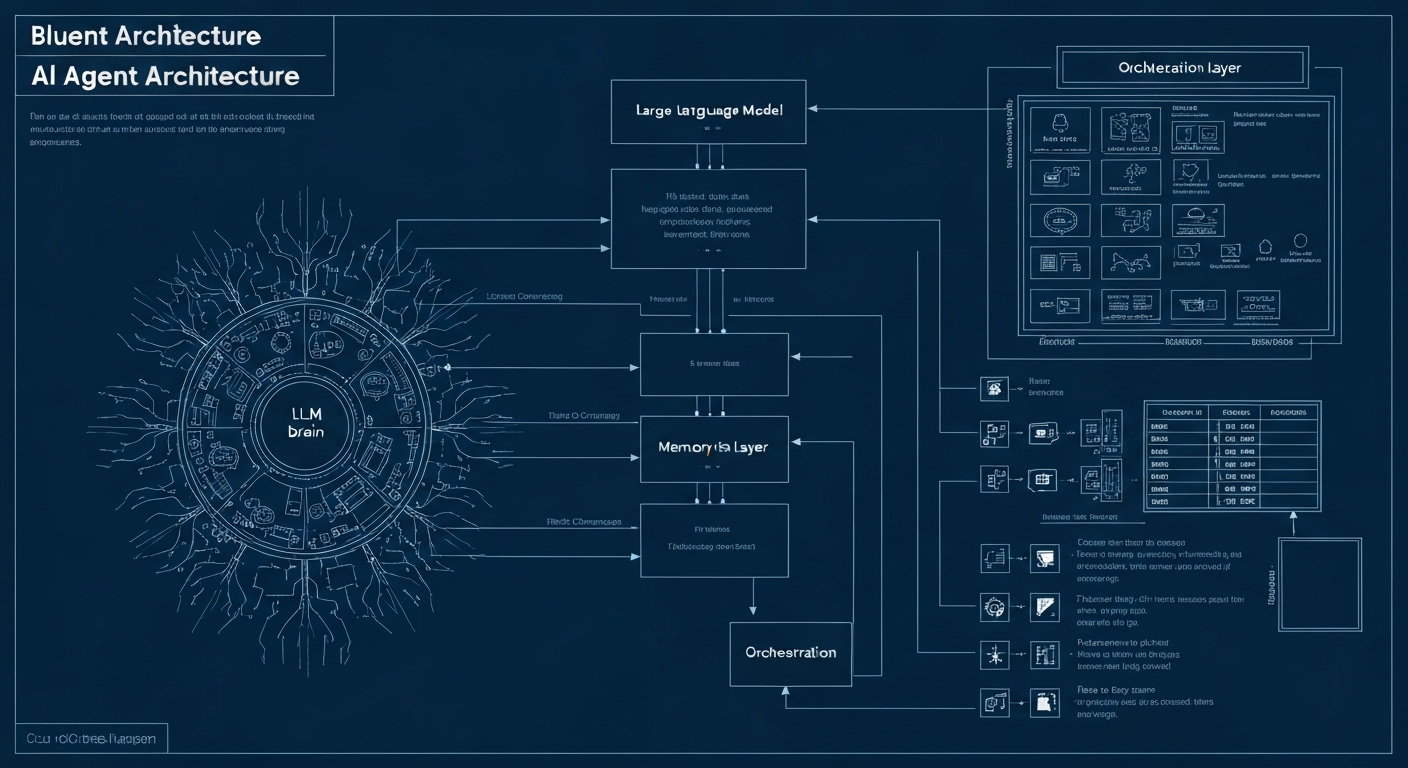
If you understand AI agents at the architectural level, you can make better decisions about implementation, vendor selection, and customisation. This article explains the four fundamental building blocks of modern AI agents: the LLM as the reasoning engine, tools for action, memory for context, and orchestration for complex workflows.
Building Block 1: The LLM (Large Language Model)
The LLM is the brain of an AI agent. It processes text, understands instructions, reasons about problems, and decides which actions need to be taken. Popular LLMs used as the core of agents are GPT-4o (OpenAI), Claude 3.5 Sonnet (Anthropic), and Gemini 1.5 Pro (Google).
The LLM receives a system prompt that defines the agent's role, goals, and available tools. Based on the input and the system prompt, the LLM determines the next action: call a tool, request more information, or generate an answer.
Building Block 2: Tools
Tools give an AI agent the ability to act in the real world. Without tools, an LLM is just a text generator. With tools, an agent can send emails, query databases, call APIs, read and write files, scrape web pages, and control external services.
- Web search tools: Search the internet for current information
- CRM tools: Create contacts, update leads, manage deals in HubSpot or Salesforce
- E-mail tools: Read, send, and reply to e-mails
- Database tools: Run SQL queries, retrieve data, and store data
- Code execution tools: Run Python code for data analysis or calculations
- Document tools: Read PDFs, create Word documents, process Excel files
Building Block 3: Memory
Memory is the component that allows an AI agent to remember context and learn. There are three types of memory:
- Short-term memory (context window): The current conversation and task. Limited to the LLM's context window (typically 128K-200K tokens).
- Long-term memory (vector database): Stored knowledge, previous interactions, and learned patterns. Stored in a vector database such as Pinecone or Weaviate.
- Episodic memory: Specific previous tasks and outcomes that the agent can retrieve as a reference for new, similar tasks.
Building Block 4: Orchestration
Orchestration determines how an AI agent handles complex, multi-step tasks. Two dominant patterns are the ReAct loop (Reason + Act) and multi-agent orchestration.
In the ReAct loop, the agent first thinks through the situation (Reason), then takes an action (Act) and observes the result (Observe), after which the process repeats until the goal is reached. This enables the agent to solve complex tasks step by step.
In multi-agent orchestration, multiple specialised agents work together. An orchestrator agent distributes tasks across sub-agents, each specialised in a specific domain. Match-AI's AI agent, for example, is built on a multi-agent architecture: a central orchestrator coordinates specialist agents for CRM, e-mail, research, and reporting.
How Match-AI Builds Agents
Match-AI uses a modular architecture in which each component, LLM choice, tools, memory strategy, and orchestration method, can be optimised separately for the specific use case. This results in agents that are not only technically advanced, but also reliable, secure, and scalable for enterprise B2B use.

Written by
Jarno de Vries
Mede-eigenaar · AI & Tech
AI- en tech-executive met ruim tien jaar ervaring in het opschalen van technologiebedrijven. Bij Match-AI richt hij zich op AI-collega’s die terugkerend MKB-werk écht overnemen.
Follow on LinkedIn