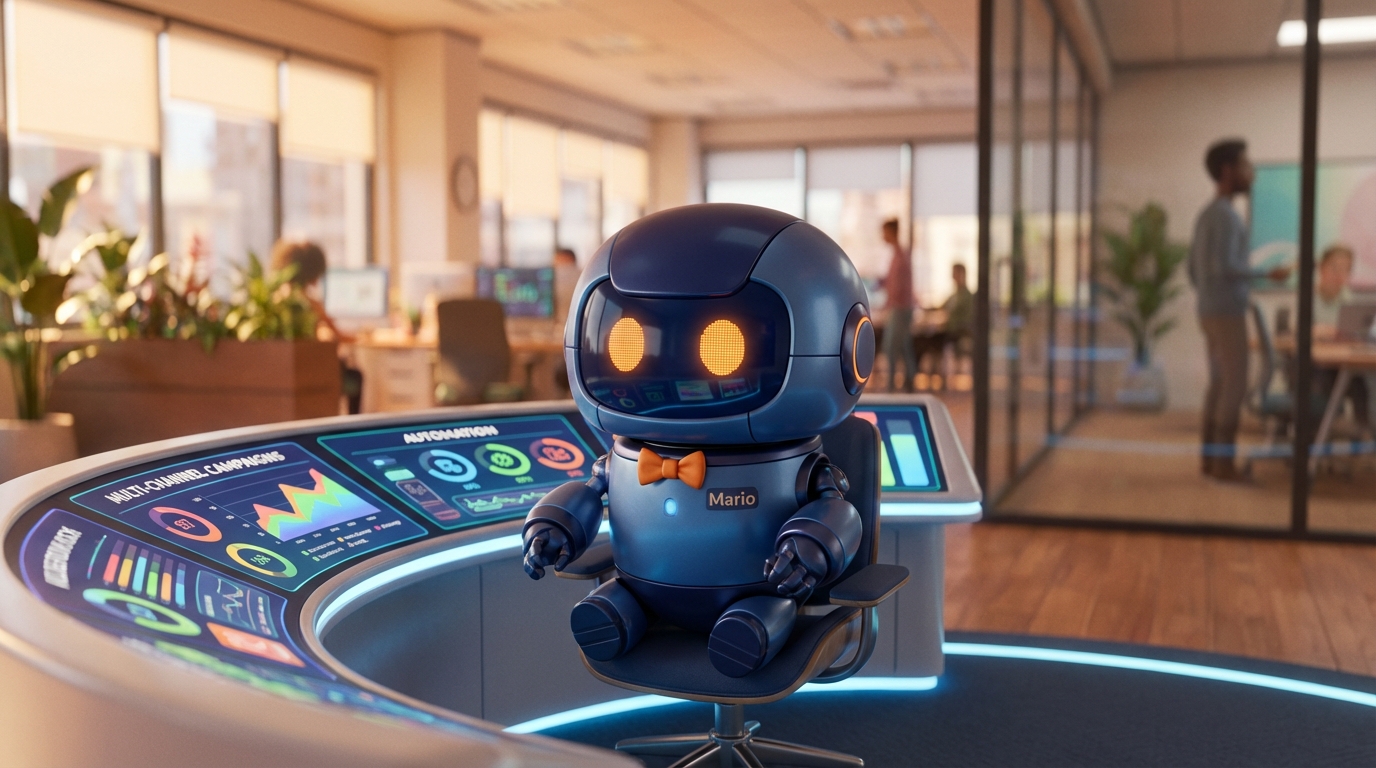
Marketing automation has come a long way since the first email autoresponders. The AI agent represents the next generation: AI-driven marketing that not only automates, but also thinks, learns and adapts to each individual prospect.
Why Traditional Marketing Automation Falls Short
Classic marketing automation tools work with predefined rules and linear workflows. An AI agent, by contrast, uses machine learning to recognize patterns, make predictions and take dynamic decisions in real time.
The AI agent treats every prospect as a unique individual, not as part of a mass segment.
The AI Agent's Marketing Intelligence
The AI agent's marketing capabilities go far beyond traditional automation:
- Behavioral Pattern Recognition: Analyzes website behavior, email interactions and content consumption to identify intent signals
- Dynamic Content Generation: Creates personalized content for every prospect based on their specific interests and pain points
- Predictive Audience Modeling: Identifies look-alike audiences and predicts which prospects are most likely to convert
- Multi-Channel Orchestration: Coordinates messages across email, social media, website and advertising platforms
- Real-time Campaign Optimization: Automatically adjusts campaigns based on performance data and external factors
- Advanced Lead Nurturing: Develops complex, non-linear nurturing paths that adapt to prospect behavior
The AI-Driven Marketing Funnel
Awareness Stage - Intelligent Content Discovery The AI agent analyzes trending topics, competitor content and audience interests to create relevant content that fits naturally with your target audience.
Interest Stage - Behavioral Trigger Mapping Based on website visits, content downloads and email engagement, the AI agent creates detailed behavioral profiles and triggers for follow-up.
Consideration Stage - Personalized Nurturing The AI agent develops unique nurturing sequences for every prospect, adjusting timing, content type and messaging to individual preferences.
Decision Stage - Intent-Based Prioritization When prospects show buying intent, the AI agent automatically prioritizes them and alerts the sales team with detailed prospect intelligence.
Advanced Segmentation & Personalization
The AI agent goes beyond traditional demographic segmentation by combining psychographic and behavioral data:
- Micro-Segmentation: Creates hundreds of small audience segments based on specific behavior patterns
- Dynamic Persona Evolution: Automatically adjusts buyer personas based on new data and interactions
- Predictive Lifetime Value: Identifies high-value prospects early in the funnel
- Churn Risk Assessment: Predicts which prospects are likely to drop off and implements preventive measures
Content Intelligence & Creation
One of the AI agent's most powerful features is intelligent content management:
Content Performance Prediction: The AI agent analyzes historical performance data to predict which content types will perform best for specific audience segments.
Automated A/B Testing: Runs continuous A/B tests on subject lines, content formats, send times and call-to-actions, with results automatically optimized.
Dynamic Content Assembly: Combines different content elements (text, images, videos) to create personalized experiences for every recipient.
Marketing ROI & Performance Metrics
Organizations that use the AI agent's marketing automation see substantial improvements:
- 45% higher email open rates through AI-optimized subject lines and timing
- 60% better click-through rates through personalized content and dynamic CTAs
- 35% shorter conversion cycles through intelligent lead nurturing
- 80% reduction in campaign setup time through automated workflow creation
- 150% increase in marketing qualified leads through better targeting and personalization
Implementation Roadmap
Phase 1: Data Foundation (Week 1-2) Integrate all marketing data sources: CRM, website analytics, social media, advertising platforms. The AI agent needs comprehensive data to make effective decisions.
Phase 2: Campaign Architecture (Week 3-4) Define your marketing goals, KPIs and target audiences. The AI agent uses these parameters to develop campaign strategies.
Phase 3: AI Training & Optimization (Week 5-8) Let the AI agent learn from your historical campaign data and start with small-scale tests to validate AI performance.
Phase 4: Scale & Automation (Week 9+) Gradually expand to full-scale automation with continuous monitoring and optimization.
The Future of AI Marketing
Marketing automation is evolving rapidly toward full AI orchestration:
- Predictive Customer Journey Mapping: AI will be able to predict and optimize complete customer journeys
- Real-time Sentiment Adjustment: Campaigns that adapt to real-time market sentiment and news events
- Cross-Platform Attribution: Clear insight into which touchpoints actually contribute to conversions
- Autonomous Budget Optimization: AI that reallocates marketing budgets in real time for maximum ROI
By investing in AI marketing automation now, you're not just building more efficient campaigns - you're creating a learning system that gets better every day at understanding and influencing your target audience.
Sources & further reading

Written by
Jorg Hartog
Mede-eigenaar · Sales & Marketing
Werkt aan de samenwerking tussen AI en mensen. Bij Match-AI vertaalt hij AI-capaciteiten naar sales- en marketingprocessen waar MKB-teams direct resultaat van zien.
Follow on LinkedIn