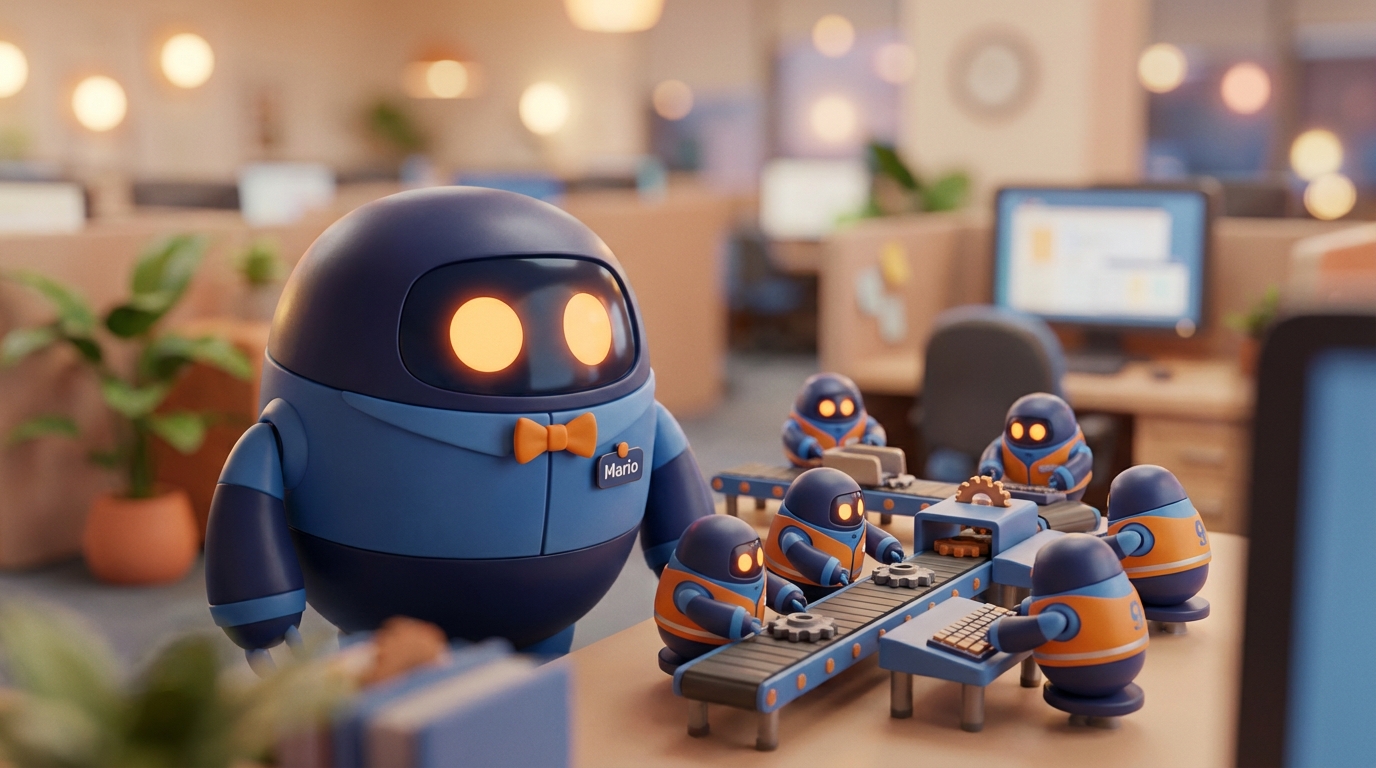
The next step after the first AI agent is a network of agents working together. Multi-agent systems divide complex tasks, check each other's work, and scale in ways a single agent never can. This is the architecture behind the most advanced AI automation of 2026.
What is a Multi-Agent System?
A multi-agent system (MAS) consists of multiple AI agents, each with a specific role or expertise, collaborating to achieve a common goal. An orchestrator agent coordinates the whole; specialist agents execute subtasks.
Advantages over a Single Agent
- Parallelization: multiple agents work simultaneously on subtasks
- Specialization: each agent optimized for its own domain
- Quality control: agents verify each other's output for higher reliability
- Scalability: add agents without restructuring the entire system
- Fault tolerance: if one agent fails, another takes over
Architecture Patterns
- Hierarchical: orchestrator directs specialist agents
- Peer-to-peer: agents communicate directly with each other
- Pipeline: output of agent A is input for agent B
- Debate: multiple agents generate solutions, a judge selects the best
Conclusion
Multi-agent systems are the future of enterprise AI automation. They make it possible to automate processes that were previously too complex for a single agent, and they do it faster, more reliably, and more scalably than any other approach.